Rust Programming Language

What is Rust?
- Developed by Mozilla
- Released version 1.0 in 2015
- Rust releases a new version every six weeks.
- Stable Edition:Rust 2015 Edition、Rust 2018 Edition、Rust 2021 Edition、Rust 2024 Edition
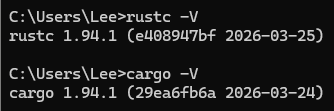
- Curerent Version: 1.94.1 (2026-03-25)
Why Rust?
- Performance: no runtime or garbage collector
- Reliability:type system and ownership model guarantee memory-safety and thread-safety
- Productivity:great documentation, a friendly compiler with useful error messages, and top-notch tooling
Build it in Rust
- Command Line
- WebAssembly
- Networking
- Embedded
Official Materials
- document: https://doc.rust-lang.org/book/
- reference: https://doc.rust-lang.org/reference/
- std: https://doc.rust-lang.org/std/
- edition-guide: https://doc.rust-lang.org/edition-guide/
- releases: https://releases.rs/
- example: https://doc.rust-lang.org/stable/rust-by-example/
- mdbook: https://rust-lang.github.io/mdBook/
- mascot:https://rustacean.net/
Chinese Materials
- 文档:https://kaisery.github.io/trpl-zh-cn/
- 教程: https://course.rs/
- 练习:https://practice-zh.course.rs/
- 周刊:https://rustcc.cn/
Getting Started
Installation
Rustup: the Rust installer and version management tool
# check installation
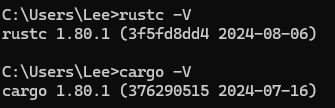
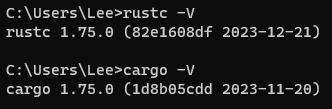
rustc --version
cargo --version
# or
rustc -V
cargo -V

# update rust
rustup update

# uninstall rust
rustup self uninstall

# open local doc
rustup docs --book
Development Environment
- VS Code + (plugin: rust-analyzer) 👍
- RustRover (by JetBrains)
Hello World!
hello_world.rs
fn main() {
    println!("Hello, world!");
}
rustc
# compile
rustc ./hello_world.rs

# run
./hello_world

# windows
.\hello_world.exe
Package Management
Cargo: the Rust build tool and package manager
cargo --version

cargo new hello_cargo
# init without git
cargo new hello_cargo --vcs none

# build in debug mode
cargo build

# build and run
cargo run

# test your code
cargo test

# checks your code to catch errors without producing an executable binary
cargo check

# build in release mode(for production)
cargo build --release

# update the dependencies to the latest versions allowed by cargo.toml
cargo update

# build documentation for your project
cargo doc --open

# publish a library to crates.io
cargo publish
- cargo doc: https://doc.rust-lang.org/cargo/
- official crate registry:https://crates.io/
- configuration file:
Cargo.toml, just likepackage.json - version control:
Cargo.lock, just likepackage-lock.json - Semantic Versioning: https://semver.org/
Programming a Guessing Game
cargo new guessing_game
cargo.toml
[package]
name = "guessing_game"
version = "0.1.0"
edition = "2021"

# See more keys and their definitions at https://doc.rust-lang.org/cargo/reference/manifest.html

[dependencies]
rand = "0.8.4"
main.rs
use rand::Rng;
// std是标准库,无需在toml文件指定依赖
use std::cmp::Ordering;
use std::io;

/**
 * main函数,函数执行的起点
 */
fn main() {
    // println! 是一个宏,不是函数
    println!("Guess the number!");
    // 默认推断为i32,但是因为后面将guess手动标记为了u32,并且将它和secret_number进行了比较,
    // 所以Rust会将secret_number也推导为相同的u32类型。
    // 1..=100 是范围表达式
    let secret_number = rand::thread_rng().gen_range(1..=100);
    // 1..101 左闭右开
    // let secret_number = rand::thread_rng().gen_range(1..101);
    loop {
        println!("Please input your guess.");
        // new是String的关联函数,类似其他语言的静态方法。
        let mut guess = String::new();
        io::stdin()
            .read_line(&mut guess)
            .expect("Failed to read line");
        // let guess: i32 = guess.trim().parse().expect("Please input a number!");
        // trim是为了移除回车输入的\n
        // 这里的guess指定为i32和u32均可
        // match 类似其他语言的switch和case
        // parse 的结果是一个Result枚举类型,有Ok和Err两个值
        let guess: u32 = match guess.trim().parse() {
            Ok(num) => num,
            // 解析失败让用户继续输入
            Err(_) => continue,
        };
        println!("You guessed: {guess}");
        // 数值类型可比较,自带cmp方法
        match guess.cmp(&secret_number) {
            Ordering::Less => println!("Too small!"),
            Ordering::Greater => println!("Too big!"),
            // 必须覆盖所有分支
            Ordering::Equal => {
                println!("You win!");
                // 退出循环
                break;
            }
        }
    }
}
cargo build
cargo run
Common Programming Concepts
Variables/Mutability
- by default, variables are immutable
- make them mutable by adding
mutin front of the variable name
Constants
- not allowed to use
mutwith constants - constants are always immutable
- the type of the constants must be annotated
- constants should be set only to a constant expression, not the result of a value that could only be computed at runtime.
| immutable variable | mutable variable | constants |
|---|---|---|
| let | let mut | const |
Shadowing
- declare a new variable with the same name as a previous variable in the same scope
- we can change the type of the value but reuse the same name.
Shadowing thus spares us from having to come up with different names, such as
spaces_strandspaces_num
Data Types
- Rust is a statically typed language
- The compiler can usually infer what type we want to use based on the value and how we use it.
- Sometimes, we must add a type annotation
- integer types default to
i32. - float types default to
f64.
| Scalar Types | Compound Types |
|---|---|
| integers | tuples |
| floating-point numbers | arrays |
| Booleans | |
| characters |
Integer Types
| Length | Signed | Unsigned |
|---|---|---|
| 8-bit | i8 | u8 |
| 16-bit | i16 | u16 |
| 32-bit | i32 | u32 |
| 64-bit | i64 | u64 |
| 128-bit | i128 | u128 |
| arch | isize | usize |
| Number literals | Example |
|---|---|
| Decimal | 98_222 |
| Hex | 0xff |
| Octal | 0o77 |
| Binary | 0b1111_0000 |
Byte (u8 only) | b'A' |
Floating-Point Types
IEEE-754
| Length | Signed |
|---|---|
| 8-bit | f32 |
| 16-bit | f64 |
fn main() {
    let x = 2.0; // f64

    let y: f32 = 3.0; // f32
}
Numeric Operations
fn main() {
    // addition
    let sum = 5 + 10;

    // subtraction
    let difference = 95.5 - 4.3;

    // multiplication
    let product = 4 * 30;

    // division
    let quotient = 56.7 / 32.2;
    let truncated = -5 / 3; // 结果为 -1

    // remainder
    let remainder = 43 % 5;
}
The Boolean Type
fn main() {
    let t = true;
    let f: bool = false; // with explicit type annotation
}
The Character Type
- four bytes
- Accented letters; Chinese, Japanese, and Korean characters; emoji; and zero-width spaces are all valid
charvalues in Rust. - Unicode Scalar Value(from
U+0000toU+D7FFandU+E000toU+10FFFF)
fn main() {
    let c = 'z';
    let z: char = 'ℤ'; // with explicit type annotation
    let heart_eyed_cat = '😻';
}
The Tuple Type
fn main() {
    let tup: (i32, f64, u8) = (500, 6.4, 1);
    let tup = (500, 6.4, 1);
    let (x, y, z) = tup

    let (mut x, y) = (1, 2);
    x += 2;

    let x: (i32, f64, u8) = (500, 6.4, 1);
    let five_hundred = x.0;
    let six_point_four = x.1;
    let one = x.2;
}
The Array Type
fn main() {
    let a = [1, 2, 3, 4, 5];
    let a: [i32; 5] = [1, 2, 3, 4, 5];
    let a = [3; 5]; // [3, 3, 3, 3, 3]

    let first = a[0];
    let second = a[1];
}
Invalid Array Element Access
- resulted in a runtime error at the point of using an invalid value in the indexing operation.
use std::io;

fn main() {
    let a = [1, 2, 3, 4, 5];

    println!("Please enter an array index.");

    let mut index = String::new();

    io::stdin()
        .read_line(&mut index)
        .expect("Failed to read line");

    let index: usize = index
        .trim()
        .parse()
        .expect("Index entered was not a number");

    let element = a[index];

    println!("The value of the element at index {index} is: {element}");
}
Functions
- fn
- snake_case
fn main() {
    println!("Hello, world!");
    another_function(5);
    print_labeled_measurement(5, 'h');
}

fn another_function(x: i32) {
    println!("The value of x is: {x}");
}
fn print_labeled_measurement(value: i32, unit_label: char) {
    println!("The measurement is: {value}{unit_label}");
}
Comments
// line comments
fn main() {
    // So we’re doing something complicated here, long enough that we need
    // multiple lines of comments to do it! Whew! Hopefully, this comment will
    // explain what’s going on.
    let lucky_number = 7; // I’m feeling lucky today
}
Statements and Expressions
- Calling a function is an expression
- Calling a macro is an expression
- A new scope block created with curly brackets is an expression
fn main() {
    let y = {
        let x = 3;
        x + 1
    };

    println!("The value of y is: {y}");
}
fn main() {
    let x = plus_one(5);

    println!("The value of x is: {x}");
}

fn plus_one(x: i32) -> i32 {
    // You can return early from a function by using the return keyword and specifying a value,
    // but most functions return the last expression implicitly.
    x + 1
}
Control Flow
if Expressions
- Rust will not automatically try to convert non-Boolean types to a Boolean
fn main() {
    let number = 3;

    if number < 5 {
        println!("condition was true");
    } else {
        println!("condition was false");
    }
}
fn main() {
    let number = 3;
    // error! Rust will **not** automatically try to convert non-Boolean types to a Boolean
    if number {
        println!("number was three");
    }
    // right!
    if number != 0 {
        println!("number was something other than zero");
    }
}
fn main() {
    let number = 6;

    if number % 4 == 0 {
        println!("number is divisible by 4");
    } else if number % 3 == 0 {
        println!("number is divisible by 3");
    } else if number % 2 == 0 {
        println!("number is divisible by 2");
    } else {
        println!("number is not divisible by 4, 3, or 2");
    }
}
Using if in a let Statement
- like ternary operator
fn main() {
    let condition = true;
    let number = if condition { 5 } else { 6 };

    println!("The value of number is: {number}");
}
Repeating Code with loop
fn main() {
    loop {
        println!("again!");
    }
}
Returning Values from Loops
fn main() {
    let mut counter = 0;

    let result = loop {
        counter += 1;

        if counter == 10 {
            break counter * 2;
        }
    };

    println!("The result is {result}");
}
Loop Labels to Disambiguate Between Multiple Loops
fn main() {
    let mut count = 0;
    'counting_up: loop {
        println!("count = {count}");
        let mut remaining = 10;

        loop {
            println!("remaining = {remaining}");
            if remaining == 9 {
                break;
            }
            if count == 2 {
                break 'counting_up;
            }
            remaining -= 1;
        }

        count += 1;
    }
    println!("End count = {count}");
}
Java
public class Main {
    public static void main(String[] args) {
        int count = 0;

        countingUp:
        while (true) {
            System.out.println("count = " + count);
            int remaining = 10;

            while (true) {
                System.out.println("remaining = " + remaining);
                if (remaining == 9) {
                    break;
                }
                if (count == 2) {
                    break countingUp;
                }
                remaining -= 1;
            }

            count += 1;
        }
        System.out.println("End count = " + count);
    }
}
C / C++ goto
#include <stdio.h>

int main()
{
    int count = 0;

counting_up:
    while (1)
    {
        printf("count = %d\\n", count);
        int remaining = 10;

        while (1)
        {
            printf("remaining = %d\\n", remaining);
            if (remaining == 9)
            {
                break;
            }
            if (count == 2)
            {
                goto counting_up_end;
            }
            remaining -= 1;
        }

        count += 1;
    }

counting_up_end:
    printf("End count = %d\\n", count);

    return 0;
}
#include <iostream>

int main()
{
    int count = 0;

counting_up:
    while (true)
    {
        std::cout << "count = " << count << std::endl;
        int remaining = 10;

        while (true)
        {
            std::cout << "remaining = " << remaining << std::endl;
            if (remaining == 9)
            {
                break;
            }
            if (count == 2)
            {
                goto counting_up_end;
            }
            remaining -= 1;
        }

        count += 1;
    }

counting_up_end:
    std::cout << "End count = " << count << std::endl;

    return 0;
}
Conditional Loops with while
fn main() {
    let mut number = 3;

    while number != 0 {
        println!("{number}!");

        number -= 1;
    }

    println!("LIFTOFF!!!");
}
fn main() {
    let a = [10, 20, 30, 40, 50];
    let mut index = 0;

    while index < 5 {
        println!("the value is: {}", a[index]);

        index += 1;
    }
}
Looping Through a Collection with for
fn main() {
    for number in (1..4).rev() {
        println!("{number}!");
    }
    println!("LIFTOFF!!!");
}
fn main() {
    let a = [10, 20, 30, 40, 50];

    for element in a {
        println!("the value is: {element}");
    }
}
Matrix
Integer Overflow
256 → u8
in debug mode: cause your program to panic at runtime
in release mode: Rust performs two’s complement wrapping.
// 解决代码中的错误和 `panic`
fn main() {
   let v1 = 251_u8 + 8;
   let v2 = i8::checked_add(251, 8).unwrap();
   println!("{},{}",v1,v2);
}
pattern matching and destructuring
#![allow(unused)]
fn main() {
let (x, y);
(x, ..) = (3, 4);
[.., y] = [1, 2];
}
explicit type conversion
#![allow(unused)]
fn main() {
let x: i32 = 5;
let mut y: u32 = 5;

y = x as u32;
}
float
#![allow(unused)]
fn main() {
let a: f64 = 0.1 + 0.2;
let b = 0.3;
let diff = a - b;
let tolerance = 10.0e-10;
assert!(diff.abs() < tolerance);
}
注意a一定要显式标注f64,否则会报错:can’t call method abs on ambiguous numeric type float
chat to u8
#![allow(unused)]
fn main() {
for c in 'a'..='z' {
		println!("{}", c as u8);
}
}
never return function
#![allow(unused)]
fn main() {
fn never_return_fn() -> ! {
    unimplemented!()
}
fn never_return_fn() -> ! {
    panic!()
}
fn never_return_fn() -> ! {
    todo!();
}
fn never_return_fn() -> ! {
    loop {
        std::thread::sleep(std::time::Duration::from_secs(1))
    }
}
}